
How to Choose the Right PS Series High Current Plug and Socket for Your Heavy Equipment
A mining conveyor system in Chile kept tripping due to overheating connectors. The original plugs were rated for 400A, but the site’s ambient temperature often exceeded 45°C. A PS Series High Current Plugs & Sockets connector rated for 630A was selected instead, operating at roughly 70% of its capacity. The overheating stopped.
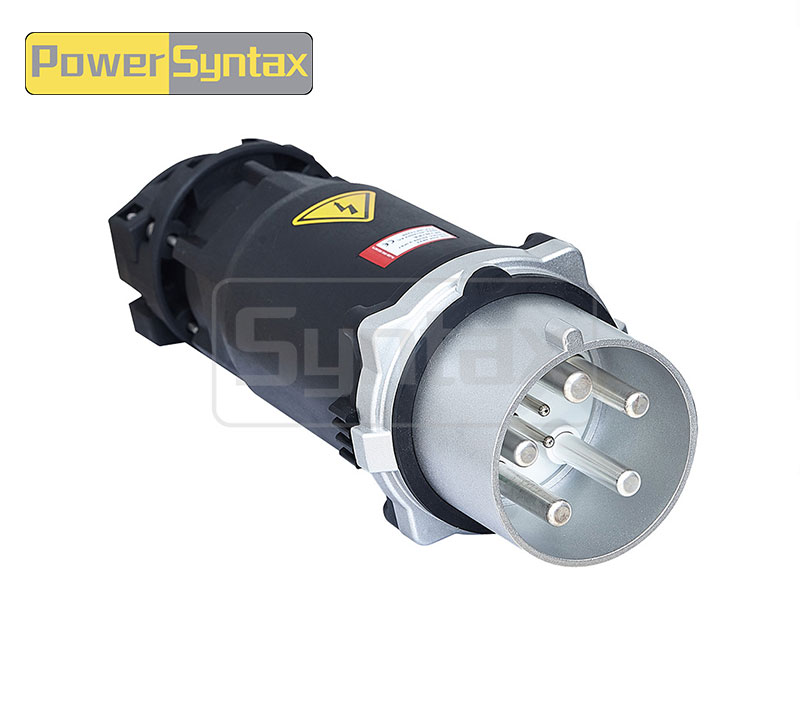
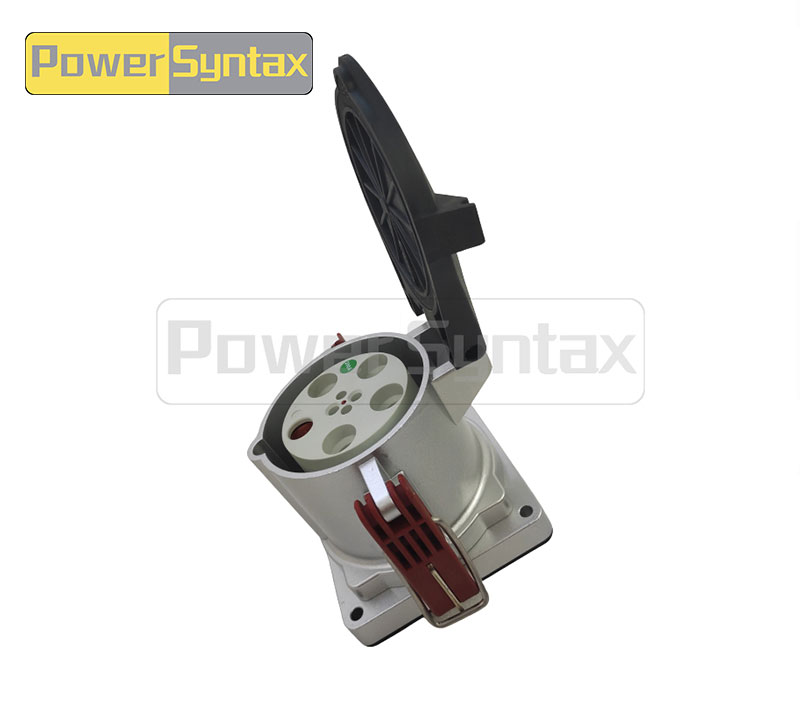
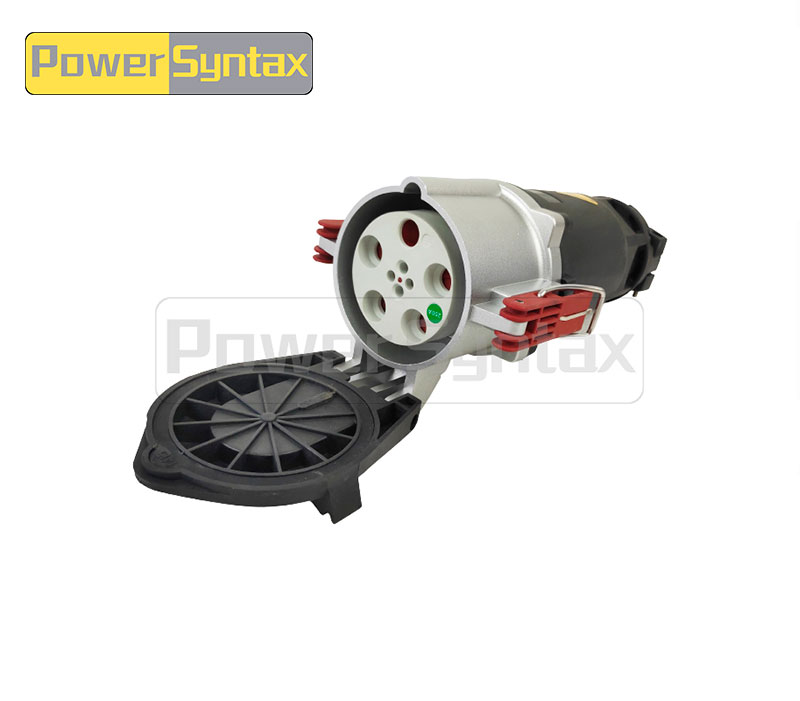
Selecting a high‑current connector is not just about matching the amperage number on the nameplate. The PS series spans 160A to 630A in 4‑pole and 5‑pole configurations, with IP66 or IP67 protection, silver contact plating, and mounting options ranging from mobile plugs to wall‑mounted sockets. This guide walks through the practical decisions behind each specification—without comparing specific brands or models—so you can match the connector to your equipment’s real operating conditions.
The Real Load: Why a 400A Connector May Not Be Enough for a 380A Motor
IP66 (dust‑tight and protected against powerful water jets) — Suitable for outdoor installations where the connector is sprayed by hoses or exposed to heavy rain. The PS series with IP66 rating withstands high‑pressure water jets from any direction, making it appropriate for washdown areas.
IP67 (dust‑tight and protected against temporary immersion) — Adds 30 minutes of submersion in 1 meter of water. For a connector mounted on a ship’s deck where waves may wash over it, IP67 provides an additional margin. However, a connector with IP67 that is continuously submerged will eventually allow water ingress, because the rating covers temporary immersion, not permanent submersion.
What IP66 and IP67 do not guarantee — IP68 is required for continuous submersion. Some manufacturers list IP66/IP67 to indicate that the connector has passed both the water jet test and the immersion test. The PS series carries both ratings, meaning it can be safely pressure‑washed and will survive temporary flooding of a cable trench.
The housing material also determines impact resistance and chemical compatibility. PA6 (polyamide 6) is lightweight, offers good insulation, and resists many industrial chemicals. For applications where the connector may be struck by heavy equipment, a metal‑housed version may be required, although the PS series primarily uses high‑grade engineering plastics with UL94 V‑0 flame rating.
| Parameter | PS Series Options | Selection Consideration |
|---|---|---|
| Current rating | 160A, 200A, 250A, 400A, 630A | Select 20‑30% above peak continuous load |
| Pole configuration | 4P (3P+E), 5P (3P+N+E) | Match equipment’s neutral requirement |
| IP rating | IP66, IP67 | IP66 for hose-down; IP67 for temporary immersion |
| Termination type | 160-400A with Screw terminals; 630A with Crimple terminals | No specialized crimp tools required |
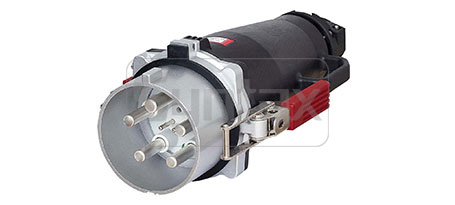
Contact Plating and Housing – Two Choices That Determine Service Life
The metal inside the connector and the plastic that surrounds it are often overlooked until they fail.
Silver‑plated contacts have lower bulk resistivity than tin and remain conductive even after surface tarnishing. The wiping action during mating cleans the silver surface, maintaining low contact resistance through thousands of cycles. This makes silver the standard choice for applications where the connector is mated and unmated regularly — portable generators, shore power connections, and mobile equipment.
The PS series uses copper alloy contacts with protective plating, designed for low contact resistance and high durability under repeated mating cycles. The contact resistance is specified at ≤0.5mΩ for new, unmated connectors.
The housing material determines impact resistance and chemical compatibility. Polyamide (PA6) is lightweight, offers good insulation, and resists many industrial chemicals. For a connector on a ship’s deck where it may be struck by mooring lines, the impact resistance of PA6 is adequate. For an underground mining application where the connector may be crushed, a metal‑housed version would be required — though the PS series primarily uses high‑grade engineering plastics with UL94 V‑0 flame rating.
IP66 means dust‑tight and protected against powerful water jets — suitable for outdoor installations where the connector is hosed down or exposed to heavy rain. IP67 adds temporary immersion (30 minutes at 1 meter depth). For a connector on a supply ship’s deck where waves may wash over it, IP67 provides an essential margin. However, IP67 does not mean the connector can be submerged continuously; that requires IP68. The PS series carries both IP66 and IP67 ratings, meaning it can be pressure‑washed and will survive occasional flooding of a cable trench.
Termination and Cable Compatibility – Keeping the Connection Cool
The PS Series High Current Plugs & Sockets use screw terminals. This simplifies field installation — a standard screwdriver is all that is needed. No specialized crimp tools, no pull‑test requirements, no need to carry spare crimping dies.
The torque spec is printed on the terminal block. Over‑tightening strips the threads; under‑tightening leads to a loose connection that heats up under load. The electrician should tighten to the specified value, typically 12‑18 N·m for a 400A model. The terminals are designed for stranded copper cable and are marked with the conductor size range.
Cable compatibility is as important as the connector’s rating. A 400A connector paired with a 25mm² cable will overheat regardless of the connector’s quality. The PS series accepts cable diameters up to 240mm² for the 400A model and the 630A model. Undersized cable will also cause a voltage drop that affects equipment performance.
For a shipyard wiring a vessel, the screw terminal is preferred because the electrician can terminate the cable with a standard tool set. For a production environment assembling hundreds of cables, a crimped connector might be faster, but the PS series is designed for field service where simplicity and tool‑less replacement are valued. The ten‑year warranty reflects confidence that the screw terminal, when properly torqued, will remain gas‑tight for the life of the connector.
What Engineers Often Ask About PS Series High Current Plugs & Sockets
Q: Can I mix a PS series plug with another brand’s socket?
No. From 160A to 400A, our plugs and sockets are designed to mate with the products by Mennekes, Bals, ABB and CEENorm, but not compatible with Marchal's, Larson's, Palazzoli's, Eaton's. While our 630A plugs and sockets are designed to mate only with their own counterparts. Mixing brands can result in mismatched contact geometries, spring forces, and sealing dimensions, leading to increased contact resistance and eventual overheating. Cross‑mating also invalidates safety certifications.
Q: What is the typical lifespan of a PS series connector under daily use?
Service life depends primarily on mating cycles and operating environment. Under normal AC load conditions, the contact system is rated for 1,000–2,000 mechanical mating cycles before noticeable wear. A connector used daily on a portable generator may require contact inspection after two years, while a shore power connector mated once per week can last well beyond five years. Environmental factors — dust, moisture, corrosive air — significantly affect longevity.
Q: Is a PS series connector suitable for DC applications?
The PS series is primarily rated for AC applications (up to 380–690V AC). Using the same connector for DC requires derating because DC arcs do not self‑extinguish every half‑cycle. A connector rated for 400A AC may be safe for only 200–250A DC. For DC applications, consult the manufacturer for specific derating curves.
Q: What is the difference between PS series and standard IEC 60309 connectors?
IEC 60309 covers industrial plugs and sockets up to 125A. The PS series extends the current range to 630A, with higher‑grade copper alloys, improved spring contact design, and IP67 sealing as standard. The PS series is built for heavy‑duty, continuous high‑current applications where standard IEC connectors would overheat or require frequent replacement.
Practical Suggestions Before You Order
For shore power or shipboard applications, choose IP67, 5‑pole configuration (3P+N+E), and silver‑plated contacts. The vessel’s neutral conductor must be accommodated, and the connector will be exposed to salt spray and occasional submersion.
For mining or tunneling equipment, select a current rating at least 25% above the maximum continuous load. The connector will operate in high ambient temperatures and dusty conditions. IP66 is sufficient; IP67 provides extra margin if the equipment may be temporarily submerged. The polyamide housing with UL94 V‑0 flame rating is required for underground mining.
For portable generators and event power, choose a mobile‑type plug with IP66, 4‑pole configuration (3P+E) for delta‑connected generators, or 5‑pole for star‑connected generators with neutral. Screw terminals are preferred for field wiring. Consider a mechanically interlocked socket if the generator may be disconnected under load.
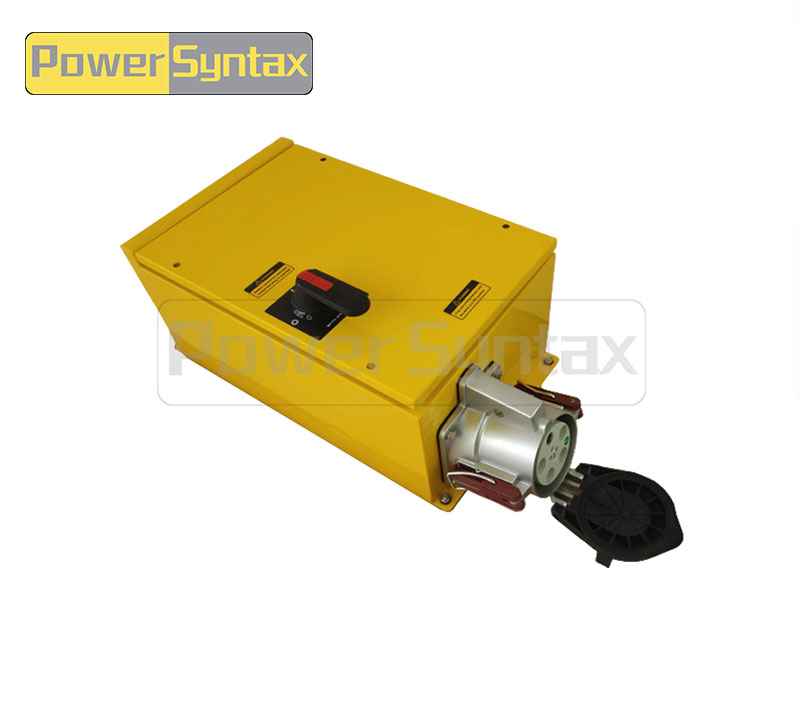
For fixed industrial machinery, a panel‑mounted straight or angled socket is appropriate. Derate the current rating by 20% if the connector is installed in an enclosed panel with limited airflow. Verify that the cable termination matches the connector’s terminal range — a 400A connector requires 70-240mm2 cable.
A PS Series High Current Plugs & Sockets system that is properly sized for the actual load, equipped with the correct contact plating and IP rating, and terminated with the right cable will provide reliable service for years. Before ordering in quantity, request a sample unit. Perform a dry mate test to confirm the coupling force is consistent and that the sealing gasket seats properly. Measure contact resistance across each pole with a milliohmmeter; a new PS series connector should read below 0.3mΩ per mated pole.
【Request a quote from Androi Elec】
Contact Hyper/NHP with your required current rating (160‑630A), pole configuration (4P or 5P), mounting style (mobile, panel, or wall), and environmental conditions to receive a PS series specification and a sample for dry mate testing.